
What's Next?
Now that you've registered, it's time to get started on your science fair project. Take a look at the handbook below for more important details and follow along in four easy steps to successfully create your science fair project. You can also find a list of helpful resources and frequently asked questions on this page to assist you in creating your project! Be creative and have fun 4-H'ers! We can't wait to see what you come up with!
Check out our updated Science Fair Handbook!
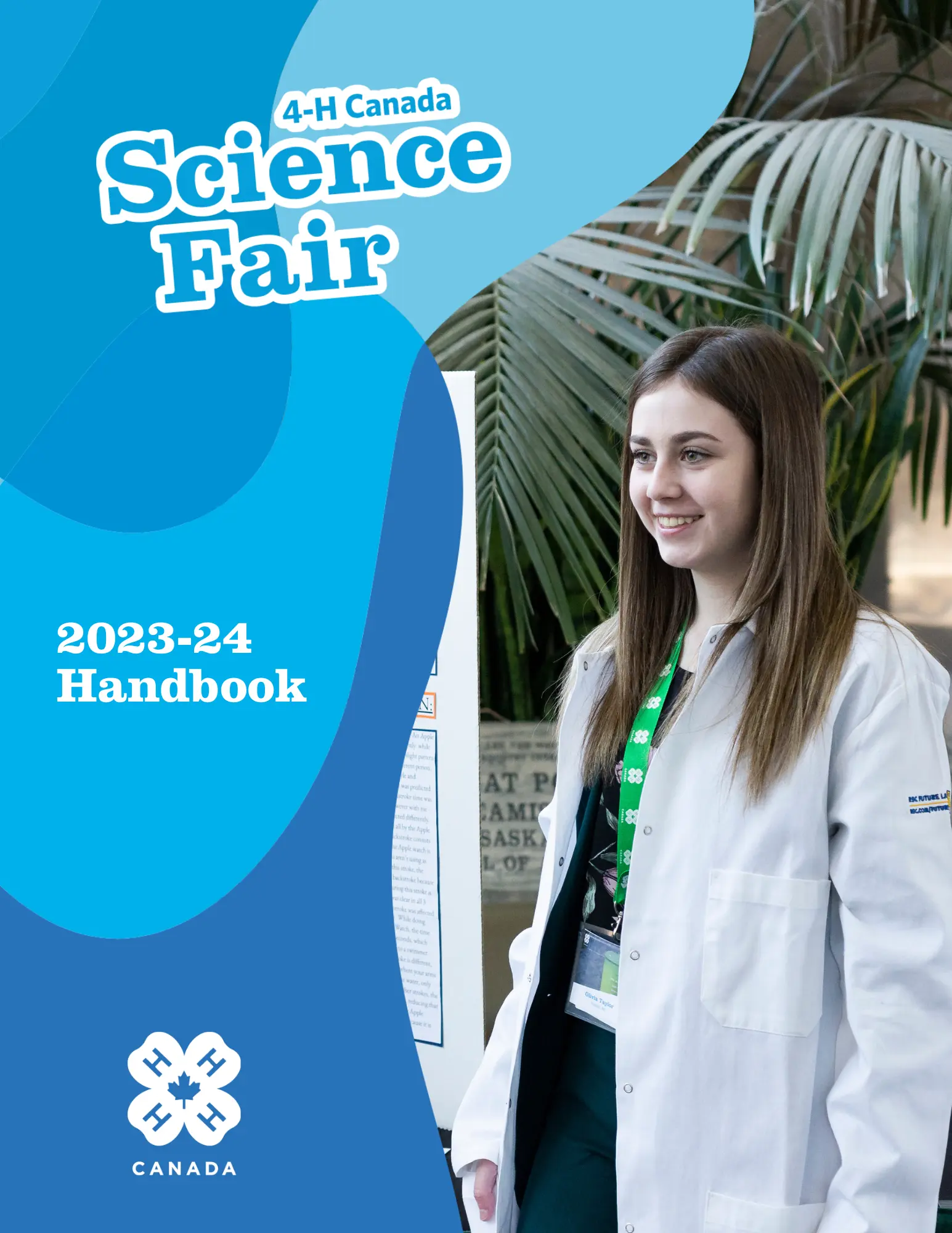
This Resource Will Guide You in Creating Your Very Own 4-H Canada Science Fair Project in Four Easy Steps:
- Individual or Partner Project?
- Pick a Topic
- Pick a Project Type
- Project Components
4-H Canada Science Fair Handbook
Frequently Asked Questions
4-H members in good standing, who are in grade 7 – 12 or studying in CÉGEP are welcome to participate.
Definitely! You may work individually or in pairs. Groups may not have more than two people per project.
Yes! You are welcome to participate in both your school’s science fair and the 4-H Canada Science Fair: First Round.
At the regional level, you can either compete in the 4-H Canada Science Fair: Second Round or your school’s regional fair – you can’t do both!
Anything! Well, almost. Click here for inspiration and read the 4-H Canada Science Fair handbook to identify topics to avoid and to understand the rules around projects involving humans or animals.
Your 4-H specialist or the 4-H office in your province can help you determine this. Some provinces count your science fair project as a “self-determined” or “create-a-project” option, or as a communications project.
The 4-H Canada Science Fair: First Round runs from Sept. 12, 2023, through Jan. 8, 2024. You can submit your project anytime between these two dates. We recommend starting your project as soon as you can so we can support you. Even if you haven’t started your project but are thinking of doing one, register here.
All the judges will have a science background. Each project will be reviewed by three judges for roughly 20 minutes. Judges are provided a 4-H Canada Science Fair rubric and scoring guide available in the handbook. Judges will assess your PowerPoint project display, your logbook, and your report.
Finalists of the 4-H Canada Science Fair: First Round will win the opportunity to attend the 4-H Canada Science Fair: Second Round (location and dates TBD). If you are successful and win at the 4-H Canada Science Fair: Second Round, you will have the opportunity to represent 4-H Canada at the Canada-Wide Science Fair in Ottawa, ON, where there is nearly $1,000,000 in scholarships and prizes to be won!
A mentor can be a teacher, guide, or advisor who supports you with your science fair project. They can have a science background, or they may just be supportive of your passion! Mentors may provide you with workspace (e.g., access to a science lab), connect you with experts, or offer encouragement. It is your responsibility to come up with the project idea, build the project, write the report, and create the PowerPoint project display.
There are many places you can find a mentor. Ask someone you think would be able to support your project like your science teacher, your 4-H club leader, a parent, or even contact someone who works at a local university or company. Find more mentor resources here.
Yes! If you are interested in supporting a 4-H member in their project, visit our Mentoring with 4-H page for important documents such as the “Letter for Mentors” and the “Code of Conduct” to review and submit.
There is no cost to participate in the First Round of the 4-H Canada Science Fair in 2023-24, as it will be held virtually. Any costs for participating in round two of the 4-H Canada Science Fair and CWSF will be covered by 4-H Canada.
Congratulations on submitting your project! You will have received a confirmation email once you submit your project. The deadline for submissions is January 8, 2024, at 11:59 p.m. ET. Judges from across Canada will judge the projects virtually. Finalists for the next round will be announced in February 2024.
The use of humans or animals in science is strictly regulated to ensure that no humans or animals are treated unethically. Read the 4-H Canada Science Fair handbook to identify topics to avoid and to understand the rules around projects involving humans or animals. If you involve humans or animals in your project, you will need to submit an ethics review request for approval before proceeding.
While your parents, club leader, or teacher can support you, the writing, experimentation, research, and conclusions need to be completed by you.
4-H Canada encourages you to take all safety precautions in your science fair project. If you are using chemicals, materials, or tools, make sure that you have read all instructions, have been trained on how to use them safely and have supervision. Talk to your parents, 4-H leaders, or teachers before starting your project. If your project feels unsafe, it probably is; do not continue. Read the 4-H Canada Science Fair handbook for more information on project safety.
Yes, you can apply for a patent if you have invented something, however, the process is quite long. There is a cost involved and you will likely need help from your parents/4-H leader/teacher and possibly a lawyer. Click here for more information.
Read this 4-H Canada Science Fair handbook in full for more details about registration. If you are still experiencing difficulties, contact 4-H Canada’s Youth Programs Manager, Chelsea Crawford at program@4-hcanada.ca.
Related Resources
Interested in Being Paired with a Mentor?
Thank You to Our Partners






Do You Have a Question about the Science Fair?
We're here to help!